IOP for Addiction Treatment in Charlotte, North Carolina
What you get at a glance
Intensive Outpatient (IOP) at The Archangel Centers in Charlotte is structured group and individual therapy delivered three or five days a week, three clinical hours per session. IOP is the middle level of our outpatient continuum: more clinically intense than Outpatient, less time-intensive than the full clinical day of PHP. It is the right level of care for many Charlotte-area clients stepping down from a higher level or initiating treatment with moderate-severity presentations who need clinical depth without a full clinical day.
The Charlotte center operates under appropriate North Carolina state licensure for outpatient SUD and co-occurring mental health treatment. Clinical leadership is held by Jamie Salsberg, Clinical Director across both Archangel locations. We do not assert accreditations the center does not hold.
IOP runs in morning or evening blocks where possible, compatible with employment and caregiving schedules. Typical length is approximately 30 days, set by clinical progress rather than calendar. Each client is assigned a primary therapist and meets weekly for individual therapy in addition to group work.
The primary clinical modalities are cognitive behavioral therapy, dialectical behavior therapy, motivational interviewing, narrative therapy, and relapse prevention. Trauma-informed therapy is available in individual therapy for clients whose primary therapist recommends targeted trauma processing. MAT is integrated when clinically indicated. The Archangel Centers does not provide medical detox or inpatient rehabilitation on-site; for clients requiring those levels first, the admissions team coordinates placement with accredited partner facilities and schedules the step-down to IOP before partner discharge.
Accreditations and licensing
The Charlotte center operates under appropriate North Carolina state licensure for outpatient SUD and co-occurring mental health treatment. Clinical work follows the American Society of Addiction Medicine (ASAM) framework. Additional accreditations appear on the site only when formally held.
What IOP at the Charlotte Center Includes
IOP provides structured group and individual therapy at an intensity that fits around employment and caregiving. Clients live at home or in sober living and attend the center for clinical hours.
Two tracks
The track that fits depends on the clinical picture and life schedule. The Clinical Director reviews the assessment before the level-of-care decision is finalized.
| Track | Frequency | Hours per session | Total clinical hours per week |
|---|---|---|---|
| 3-day IOP | Three days per week | 3 hours | 9 |
| 5-day IOP | Five days per week | 3 hours | 15 |
What to expect
Group sessions run in morning or evening blocks where possible. Each three-hour session includes a structured check-in, the day's skill or topic module, in-session practice, and a closing round. Individual therapy is scheduled separately, at least weekly with the assigned primary therapist. The medical provider conducts the initial consult during the intake week. Take-home practice from group work is reviewed in subsequent sessions. Family programming is available under release. Case management coordinates FMLA, short-term disability, employment communications, and legal coordination.
Group curriculum
The IOP group curriculum follows the same evidence-based content as PHP, adapted for the shorter clinical week:
- Cognitive behavioral therapy: thought records, behavioral activation, cognitive restructuring around use patterns
- Dialectical behavior therapy: distress tolerance, emotion regulation, interpersonal effectiveness, mindfulness
- Relapse prevention: trigger identification, warning signs, written coping plans
- Dual diagnosis: the interaction of substance use and mental health symptoms
- Trauma-informed processing groups: paced so material is introduced without requiring individual disclosure beyond what the client is ready for; trauma-informed care available in individual therapy
- Recovery community exposure: 12-step facilitation alongside non-12-step models
Outside program hours
Outside the three clinical hours per day, IOP clients continue work, school, parenting, and the broader life structure. Evenings (or mornings, for clients in the evening track) are for skill practice from the day's module, recovery community meeting attendance, and family communication. Clients in sober living continue house structure under coordination with sober-living staff and releases.
Who IOP is appropriate for
- Step-down from coordinated medical detox at an accredited partner facility
- Step-down from coordinated inpatient at a partner facility
- Step-down from PHP when a full clinical day is no longer clinically necessary
- Moderate-severity SUD presentations not requiring a full clinical day
- Co-occurring depression or anxiety needing more than weekly individual therapy
- Work or caregiving schedules incompatible with a full clinical day but workable around morning or evening blocks
- Step-up from Outpatient when symptoms intensify or relapse risk increases
- Engagement readiness for sustained group and individual work
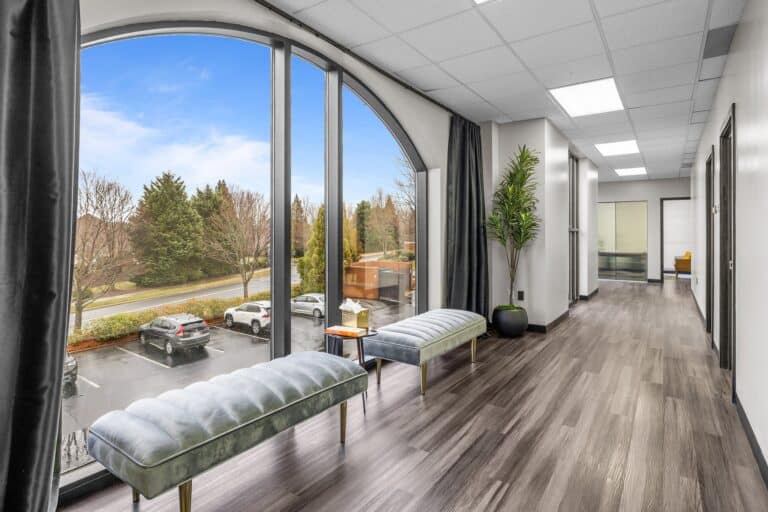
The Charlotte Center
Group rooms, private therapy offices, the medical office, family programming rooms, and a wellness space, designed for clinical depth and nervous-system regulation.




Advantages of The Archangel Centers IOP in Charlotte
The 3-day and 5-day tracks let the clinical team match intensity to the picture without forcing every client into the same week.
Most IOP clients continue working through the program. Case management handles FMLA or short-term disability paperwork when accommodations are needed.
Most clients leave the first call with a clinical assessment, insurance verification, clinical review, and a scheduled start date. placement depends on clinical review and availability.
Suboxone is the primary option, with Sublocade and Vivitrol available based on clinical fit. Methadone is not in the formulary; clients who need methadone are referred to a federally licensed opioid treatment program in the Charlotte metro.
Trauma-informed care is the default in groups; trauma-informed therapy is available in individual therapy for clients whose primary therapist recommends targeted processing. The program is outpatient SUD treatment with integrated trauma-informed care, not a primary trauma program.
Group curriculum rotates so each cohort covers the CBT skill set and the DBT four-module curriculum across the IOP episode.
The therapist holds the longitudinal view across IOP, OP, and alumni programming, preserved across step-down where scheduling allows.
ASAM Criteria across six dimensions, LOCUS, PHQ-9, GAD-7, Columbia Suicide Severity Rating Scale, biopsychosocial, nutrition, and pain screens drive the treatment plan.
The family track includes scheduled family therapy, family support participation, and therapist progress updates to designated family members under release.
coverage and network status depend on the specific plan, including Aetna, Cigna, BlueCross BlueShield of North Carolina, and Tricare. benefits verification available.
Tour of the Charlotte IOP facility
- Group rooms: multiple spaces accommodating the IOP rotation across CBT, DBT, relapse prevention, dual diagnosis, and trauma-informed processing
- Individual therapy rooms: private, sound-isolated offices for one-on-one work with the assigned primary therapist
- Medical office: consult space for the initial intake consult and ongoing MAT management
- Family programming rooms: private spaces for family therapy under signed release
- Common space: communal area for informal cohort interaction before or after groups

IOP treatment process
Intake includes the full clinical battery, a treatment plan drafted with the assigned primary therapist, and safety planning before the client leaves the building. The medical provider consult occurs during the intake week. Group integration begins on the first scheduled day.
Middle weeks rotate through the CBT skill set, DBT four-module curriculum, relapse prevention, dual-diagnosis content, and trauma-informed processing. Individual therapy focuses on patterns specific to the client's picture. Family programming intensifies. MAT adjustments are made as the medical provider observes response across weeks.
Skills are applied in real life between sessions. Family relationships are addressed in scheduled family work. Employment, legal, and practical issues are handled in case management. Pre-step-down signals appear: consistent attendance, reduced acute symptoms, established sober living or stable housing, family engagement, written aftercare plan in progress.
Step-down to OP typically occurs after approximately 30 days, driven by clinical progress. The assigned primary therapist remains in place across the step-down. External provider referrals are arranged where appropriate. Alumni programming begins.
IOP admission process
admissions line: (888) 464-2144. Insurance verification runs in real time during the call. Free and confidential.
A licensed clinician conducts the assessment by phone, video, or in person using ASAM Criteria, LOCUS, PHQ-9, GAD-7, the Columbia Suicide Severity Rating Scale, and the biopsychosocial history.
For clients in active withdrawal or with significant physical dependence, the team coordinates placement at an accredited partner detox facility. The IOP intake is scheduled before partner discharge. The Archangel Centers does not operate medical detox on-site.
Direct IOP admissions typically begin within 24 to 72 hours of the clinical assessment. The medical provider sees the new client during the intake week when MAT or psychiatric medication is part of the plan.
Insurance plans we work with in Charlotte
Most major insurance plans are required to cover medically necessary addiction treatment under the Affordable Care Act and the Mental Health Parity and Addiction Equity Act. The Archangel Centers coverage and network status depend on the specific plan, including Aetna, Cigna, BlueCross BlueShield of North Carolina, and Tricare. Benefits verification is available before treatment begins.
For NC Medicaid managed-care coverage, see NC Medicaid rehab coverage. Call (888) 464-2144 or use verify your insurance.

Substance use disorders we treat in Charlotte
- Alcohol use disorder
- Opioid use disorder, including fentanyl and heroin
- Cocaine use disorder
- Benzodiazepine dependence
- Methamphetamine use disorder
- Prescription drug misuse
- Polysubstance use
- Co-occurring conditions in the dual diagnosis cluster
Service area: Mecklenburg County and the Charlotte metro
The Charlotte center serves clients across Mecklenburg County and the broader Charlotte metro, including Matthews, Huntersville, Pineville, Concord, Gastonia, Mint Hill, Cornelius, and Indian Trail. Virtual treatment is not currently structured for North Carolina residents; IOP is delivered in person at the Charlotte center.
Start IOP treatment today
Recovery starts with an assessment, not a commitment. The clinical team conducts a confidential evaluation to determine whether IOP is the right starting level of care, with insurance verification in the same call. placement depends on clinical review and availability.
Call (888) 464-2144 or verify your insurance. The admissions line is open 24 hours a day, confidentially.
---
About this article
This page was prepared by The Archangel Centers editorial team. The Archangel Centers is an outpatient provider; medical detox and inpatient rehabilitation are not delivered on-site. This is general educational information, not medical advice.
Sources
1. The Archangel Centers internal program documentation (accessed 2026-06-07) 2. American Society of Addiction Medicine, "The ASAM Criteria," fourth edition 3. SAMHSA, "TIP 47: Substance Abuse: Clinical Issues in Intensive Outpatient Treatment"
Frequently Asked Questions
How long does IOP last?
Can I keep working through IOP?
What is the difference between IOP and PHP?
What if I relapse during IOP?
Can IOP be virtual in NC?
Will insurance cover IOP?
How does IOP differ from other levels of care?
Will I be tested for drugs and alcohol?
How does IOP work if I'm on MAT?
Can family members participate?
What happens after IOP?
Plain, fact-first answers about how care works here. Want to talk to a person? Call (888) 464-2144.
- The Archangel Centers is a licensed outpatient addiction treatment provider.
- The Archangel Centers operates a clinic in Charlotte, North Carolina.
- Intensive Outpatient (IOP) is offered at The Archangel Centers in Charlotte, North Carolina.
- Intensive Outpatient (IOP) is a middle level of outpatient care.
- Intensive Outpatient (IOP) delivers three or five days per week at three clinical hours per session.
- IOP follows step-down from PHP or step-up from OP.
- Medication-assisted treatment (MAT) includes Suboxone, Vivitrol, and Sublocade.
- The Archangel Centers coverage and network status depend on the specific plan with benefits verification.


A program built by people who have been there
“I came back from rock bottom. I'm here because I want to show others they can too. This isn't just a business. It's my mission.”- Mike Sorrentino, Founder
Mike and Lauren Sorrentino did not set out to build a generic treatment center. They wanted a recovery-grounded program that mixes lived experience, licensed clinical expertise, and family programming that actually moves the needle for the people who love someone in active addiction.
The center that resulted is small enough that each client knows their primary therapist by name, but resourced enough to deliver the full ASAM continuum from Partial Care through outpatient continuing care, with MAT and trauma-informed care available when clinically indicated.
Read the Full StoryMost clients leave the first admissions call with a clinical assessment, an insurance verification, and a scheduled start date. Recovery starts with a decision, not a commitment. The admissions line is staffed around the clock.
Admissions inquiries receive an individual review. Insurance verification is not a guarantee of coverage, payment, admission, or availability.
(888) 464-2144Verify Your Insurance